Why Knowing More Words Won’t Make You Fluent in English
Many English learners believe that fluency comes from one thing: vocabulary.
As a result, they spend years memorizing word lists, flashcards, and dictionaries, hoping that one day they’ll suddenly be able to speak naturally and confidently.
Yet despite knowing hundreds or even thousands of words, many learners still struggle to express themselves in conversation.
Why?
Because vocabulary alone is not enough.
The real challenge of speaking English isn’t remembering words. It’s knowing how to put those words together quickly and naturally without translating from your native language.
The Hidden Problem Behind Speaking Difficulties
Imagine you know the following words:
- tired
- work
- late
- stay
- home
Most learners would recognize all of them immediately.
However, could you instantly produce the sentence:
“I stayed home because I was tired after working late.”
Many learners hesitate.
Not because they don’t know the vocabulary, but because they haven’t mastered the structures that connect those words together.
This is often the stage where students get stuck. They have enough vocabulary to communicate, but they still try to construct sentences word by word through translation.
Translation is slow.
Fluent communication is fast.
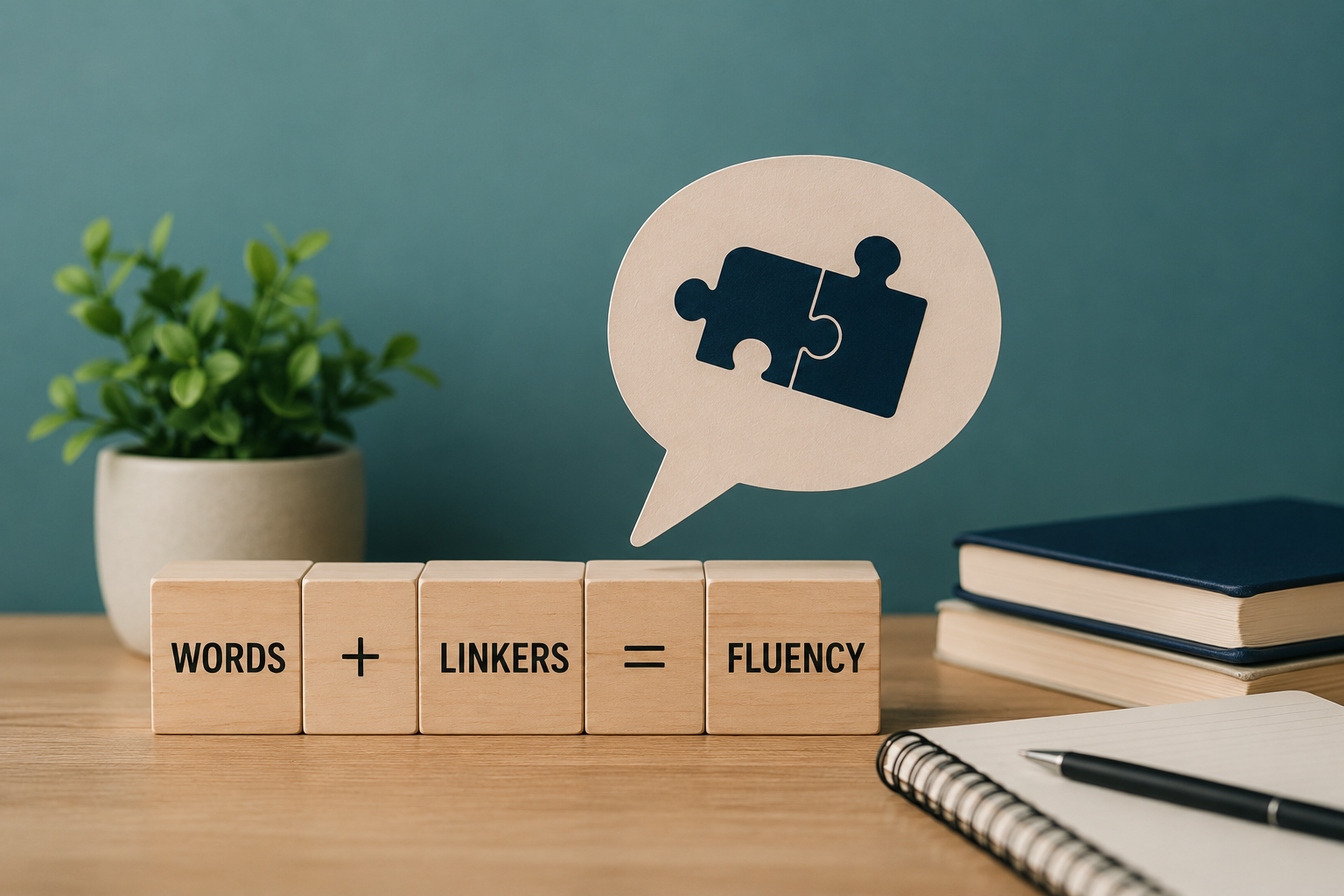
To bridge the gap, learners need to focus on something that is often overlooked: linkers and sentence-building constructions.
What Are Linkers and Sentence-Building Constructions?
Linkers are words and expressions that connect ideas.
Examples include:
- because
- because of
- even though
- although
- instead of
- as soon as
- therefore
- that’s why
- in order to
- due to
Sentence-building constructions are larger patterns that help speakers organize and express thoughts.
Examples include:
- The reason is that…
- The reason why…
- Not only… but also…
- If I were you…
- It depends on…
- What I mean is…
- It turns out that…
These patterns are the real building blocks of fluent speech.
They allow speakers to connect ideas smoothly and express complex thoughts without needing advanced vocabulary.
Why Memorizing Situational Phrases Isn’t Enough
Many language courses focus heavily on situations such as:
- Ordering coffee
- Checking into a hotel
- Introducing yourself
- Asking for directions
While these phrases can be useful for beginners, they don’t create fluency.
Real conversations are unpredictable.
People don’t always ask the questions you’ve prepared for.
Life doesn’t follow a script.
A learner who has memorized ten dialogues may still struggle to express an original thought.
For example, consider this sentence:
“I wanted to go out, but it started raining, so I decided to stay home instead.”
This is the kind of sentence native speakers use every day.
Notice that the vocabulary is simple.
The fluency comes from the connectors:
- but
- so
- instead
These small words make communication possible.
How Native Speakers Build Sentences
Native speakers rarely construct sentences one word at a time.
Instead, they rely on chunks and patterns that have become automatic through years of exposure.
Common examples include:
- On the other hand…
- As far as I know…
- The thing is…
- It turns out that…
- What I mean is…
- The reason why…
These expressions help speakers organize their thoughts, create cohesion, and speak without constantly searching for words.
In many cases, learning one useful construction can improve your speaking ability more than learning twenty new vocabulary items.
How to Learn English More Effectively
If your goal is fluency, try shifting your focus.
Instead of only collecting new words, start collecting sentence builders.
When you learn a new construction, don’t stop at understanding its meaning.
Practice using it.
Create multiple examples.
Use it in conversations.
Listen for it in podcasts and videos.
Notice how native speakers use it in context.
For example, if you learn the linker in order to, don’t memorize a single sentence.
Create several:
- I’m studying every day in order to improve my English.
- She left early in order to avoid traffic.
- We saved money in order to travel abroad.
This kind of practice helps constructions become automatic.
And automatic language is what creates fluency.
The Real Goal of Language Learning
Fluent speakers are not people who know the most words.
They are people who can connect ideas quickly and naturally.
Vocabulary is important, but vocabulary alone doesn’t create communication.
The key is learning the structures that turn individual words into meaningful messages.
So if you feel stuck despite knowing a lot of English vocabulary, don’t assume you need another thousand words.
You may simply need more linkers, connectors, and sentence-building patterns.
That’s often the missing piece between knowing English and actually speaking it fluently.
Free Practice Worksheet
If you’d like to practice the most useful linkers and sentence-building constructions, download the free worksheet available on my website.
The exercises are designed to help you stop translating word by word and start building sentences more naturally.
You can also follow me on Instagram, where I regularly share reels with practical linkers, connectors, and sentence-building expressions that will help you sound more fluent and confident in English.