You know the feeling:
You want to say something in English. First, you think of a word in your language. Then you try to translate it. Finally, you say the first English word that comes to mind.
For many learners, that word is often:
good
bad
nice
interesting
big
And while these words are perfectly correct, relying on them all the time can make your English sound basic and repetitive.
If you want to move from intermediate English to a more advanced level, one of the most powerful habits you can develop is learning synonyms.
Not by memorizing endless vocabulary lists. But by creating connections between words.
Let’s see why this works.
Why Translating Limits Your English
Many learners treat vocabulary as a dictionary. One word in their language equals one word in English.
For example:
good = good
happy = happy
big = big
The problem is that communication isn’t that simple. Native speakers rarely depend on a single word to express an idea. Instead, they have a range of options.
Imagine you’re talking about a restaurant. You could say: The food was good.
That’s correct. But you could also say:
The food was excellent.
The food was outstanding.
The food was fantastic.
Each word adds more precision and personality to your message. The more options you have, the more natural your English becomes.
Think in Vocabulary Chains
One of the easiest ways to expand your vocabulary is to stop learning words individually. Instead, learn them in chains.
For example:
Good
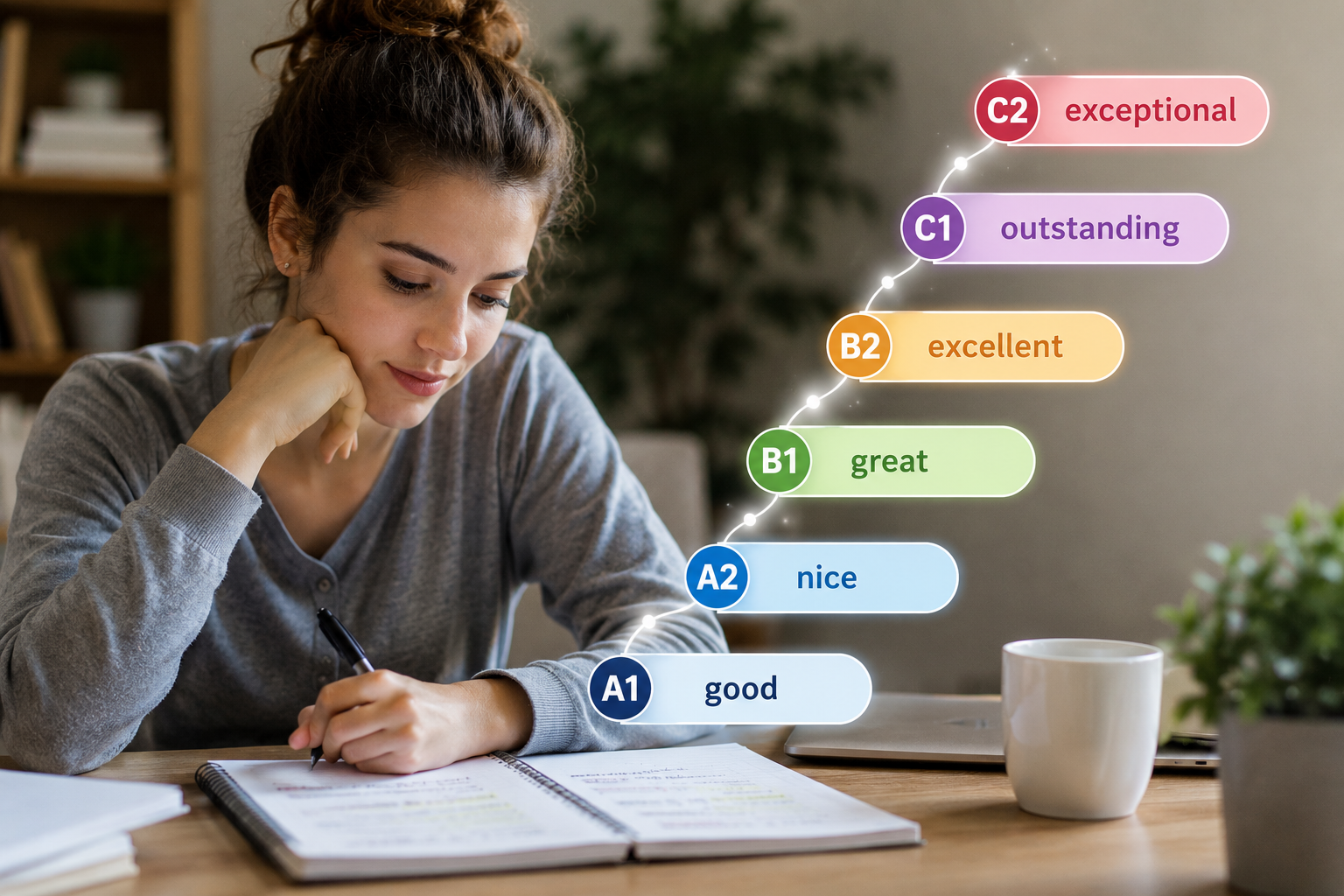
Good → Great → Excellent → Outstanding
Now you don’t have one word. You have four.
Let’s try another one:
Happy
Happy → Pleased → Delighted → Thrilled
Notice how the meaning becomes stronger as you move along the chain.
Now compare these sentences:
I was very happy about the news.
I was thrilled about the news.
Which one sounds more expressive? Which one sounds more natural? Learning vocabulary in chains helps you choose the right word for the situation.
Your Brain Loves Connections
Have you ever learned a new word and forgotten it a few days later? That’s normal. The brain remembers connected information much better than isolated information.
Imagine learning these words separately:
large
huge
massive
enormous
You might forget some of them. But if you learn them as a chain:
Big → Large → Huge → Massive → Enormous
your brain starts building relationships.
When you remember one word, the others become easier to recall. This is exactly how vocabulary grows naturally.
Stop Memorizing Lists
Many learners spend hours studying long vocabulary lists.
The result? They recognize the words but rarely use them.
A better approach is to learn words in context.
Take the word:
Interesting
Instead of writing it on a list, create a chain:
Interesting → Fascinating → Captivating → Compelling
Then put the words into sentences:
The book was interesting.
The documentary was fascinating.
Her story was captivating.
The speaker gave a compelling presentation.
Now you’re learning vocabulary and usage at the same time. That’s much more effective.
How Synonyms Improve Speaking Fluency
One reason learners struggle to speak fluently is that they run out of words.
Imagine you’re telling a story. Without synonyms:
It was good. The food was good. The hotel was good. The people were good.
Your vocabulary quickly reaches its limit.
Now imagine you know alternatives:
The hotel was excellent.
The food was outstanding.
The people were incredibly friendly.
Suddenly, your English becomes richer and more engaging. And because you’ve learned these words as connected groups, they come to mind more quickly. That’s a major step toward fluency.
A Simple Vocabulary Challenge
Choose one basic English word you use all the time.
For example:
- good
- bad
- happy
- interesting
- big
Now create a chain of at least four synonyms.
Example:
Interesting → Fascinating → Captivating → Compelling
Write your chain down and try to use each word in a sentence this week. You’ll be surprised how quickly your vocabulary starts expanding.
Final Thoughts
If you want to take your English to the next level, don’t just learn more words.
Learn better connections between words.
Stop relying on translation.
Start building vocabulary networks.
When words are connected, they’re easier to remember, easier to use, and easier to understand when listening to native speakers.
Little by little, you’ll find yourself using more precise vocabulary, speaking more confidently, and sounding more natural in English.
Want More Synonym Practice?
Every week I share synonym chains from A1 to C2 level on Instagram and YouTube Shorts.
Follow along to discover new vocabulary, expand your word bank, and learn how advanced speakers express themselves naturally.