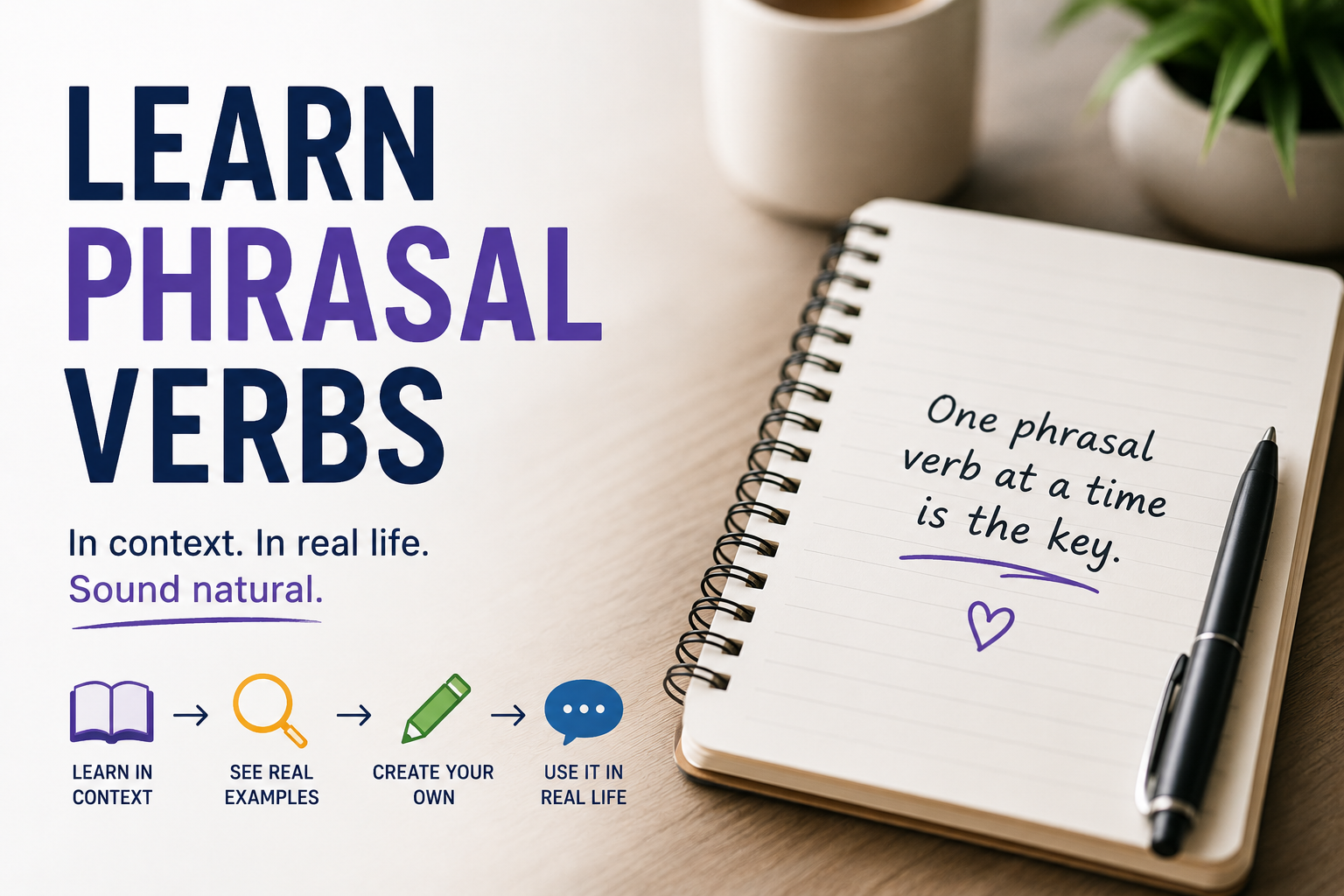
Phrasal verbs are one of the most challenging areas of English for many learners. There are thousands of them, and some phrasal verbs have more than one meaning. Because of this, students often spend a lot of time studying phrasal verbs but still struggle to use them naturally in conversation.
In this article, I’d like to explain why phrasal verbs are important and, more importantly, how to learn them effectively.
Are Phrasal Verbs Necessary?
The first thing to understand is that phrasal verbs are not obligatory.
You can speak excellent English without using many phrasal verbs. Native speakers will understand you perfectly well if you choose more formal verbs instead.
For example:
- postpone → put off
- continue → carry on
- reject → turn down
- discover → find out
Both versions are correct. However, phrasal verbs are very common in everyday English, so using them can make your speech sound more natural, relaxed, and conversational.
Think of phrasal verbs as an extra tool rather than a requirement.
Why Many Learners Struggle with Phrasal Verbs
A common learning method is to memorize long lists of phrasal verbs.
Students often study twenty or thirty phrasal verbs at a time, learn their definitions, and then move on to the next list.
The problem is that understanding a definition does not mean you can use a phrasal verb when speaking.
Many learners recognize phrasal verbs when they read or hear them, but those same phrasal verbs never come to mind during a conversation.
This is because language is not learned through memorization alone. To use a phrasal verb naturally, you need experience with it.
Learn One Phrasal Verb at a Time
Instead of trying to learn many phrasal verbs at once, focus on one phrasal verb at a time.
This allows you to become familiar with its meaning, usage, and typical contexts before moving on to another one.
When you study only one phrasal verb, you can give it the attention it deserves. As a result, you are much more likely to remember it and use it actively.
Always Learn Phrasal Verbs in Context
One of the biggest mistakes learners make is studying phrasal verbs in isolation.
For example, you might learn:
put off = postpone
While this definition is correct, it is not enough.
To really learn a phrasal verb, you need to see it in context.
For example:
- We had to put off our trip because of the weather.
- Don’t put off your homework until the last minute.
- They decided to put off the meeting until next week.
By seeing multiple examples, you begin to understand how the phrasal verb works in real situations.
Find the Formal Alternative
A useful technique is to identify the more formal verb that a phrasal verb can replace.
For example:
- postpone → put off
- continue → carry on
- discover → find out
- reject → turn down
- invent an idea → come up with an idea
This creates a mental connection between a word you already know and a new phrasal verb.
The next time you are about to use the formal verb, the phrasal verb may come to mind as an alternative.
Read and Listen to More Examples
After learning the meaning of a phrasal verb, look for additional examples.
Read articles, watch videos, listen to podcasts, or search for authentic examples online.
The more often you encounter a phrasal verb in different situations, the stronger your understanding becomes.
Repeated exposure helps move the phrasal verb from passive knowledge to active use.
Create Your Own Examples
Reading examples is important, but creating your own examples is even more valuable.
Think about your life, your work, your studies, or your daily routine.
How could you use the phrasal verb in a sentence that is meaningful to you?
Personal examples are easier to remember because they are connected to your own experiences.
The Real Goal
The goal is not simply to know the meaning of a phrasal verb.
The goal is to use it.
Many learners can explain a phrasal verb perfectly but never use it when speaking.
A phrasal verb becomes part of your active vocabulary when it appears naturally in your mind during a conversation or while writing.
That is why deep learning is usually more effective than studying large numbers of phrasal verbs superficially.
A Simple Learning Process
Here is a practical method you can follow:
- Choose one phrasal verb.
- Learn its meaning.
- Identify the formal verb it can replace.
- Read and listen to several examples.
- Create your own examples.
- Use it in conversation or writing.
- Repeat the process with another phrasal verb.
By following these steps consistently, you will gradually build a strong and usable knowledge of phrasal verbs.
Check Your Knowledge
To help you focus on the most useful phrasal verbs, I’ve prepared a list of B2-level phrasal verbs.
Go through the list and ask yourself:
- Which phrasal verbs do I already use confidently?
- Which ones do I understand but never use?
- Which ones are completely new to me?
This will help you identify the phrasal verbs that deserve your attention.
And if there is a phrasal verb that still gives you trouble, leave a comment below. I’d be happy to explain it.
You can also check out my series of Reels and Shorts, where I introduce one phrasal verb at a time, always in context and with practical examples.