If you always use the Past Simple when talking about your past, your English may be perfectly correct, but it can sometimes sound a little basic. Think about how often we talk about our childhood, our school years, previous jobs, old habits, or simply how different our lives were five or ten years ago. The Past Simple can certainly do a lot of this work, but English gives us other ways to express these ideas more precisely and naturally.
Two particularly useful structures are used to and would. Both can help us describe the past, and in some situations they can even be used to express very similar ideas. However, they are not completely interchangeable. Understanding the difference between them can give you much more flexibility when you speak and help you tell stories about your past more naturally.
I have a personal reason for thinking that used to is particularly worth learning. When I took my IELTS Speaking exam, it was one of the structures I deliberately tried to use whenever I talked about my childhood, past habits, or ways in which my life had changed. I probably overused it a little! Still, I genuinely believe it helped me get some extra points because it allowed me to demonstrate a wider range of grammar instead of relying on the Past Simple all the time.
What Does “Used To” Actually Mean?
Let’s start with a simple sentence: I used to drink coffee every morning.
At first, this might seem like another way of saying I drank coffee every morning, but there is an important difference. When I say I drank coffee every morning, I simply give you information about something that happened regularly in the past. When I say I used to drink coffee every morning, however, I usually communicate an additional idea: I don’t do it anymore.
This contrast between the past and the present is one of the most useful features of used to. It allows us to communicate not only what our life was like before, but also, indirectly, that something has changed. In a way, used to tells a small story in itself: that was my life then; this is my life now.
The structure is straightforward:
subject + used to + base verb
For example: I used to live in London. She used to work in an office. We used to go there every summer. They used to spend their weekends together.
When Do We Use “Used To”?
One of the most natural contexts for used to is childhood. We often use it when remembering things we regularly did when we were younger: I used to spend every summer at my grandparents’ house or We used to play outside until it got dark. It is equally useful for talking about school and university: I used to study late at night before exams, I used to hate maths at school, or My friends and I used to meet after class for coffee.
Another common context is talking about a previous lifestyle. Perhaps you used to work in an office but now work from home. Maybe you used to go out almost every weekend but now prefer quiet evenings at home. Perhaps you simply used to have much more free time. In all of these cases, used to naturally highlights the difference between your past and present life.
However, used to is not limited to repeated actions. We can also use it for past states, feelings, beliefs and preferences. For example, you might say I used to be very shy, I used to think English grammar was incredibly difficult, I used to love horror films, or I used to want to live abroad. These examples are particularly important because they reveal the main difference between used to and would.
Used To vs Would: What’s the Difference?
Sometimes we can use either used to or would to talk about repeated actions in the past. For example, When I was a child, I used to visit my grandparents every summer can also be expressed as When I was a child, I would visit my grandparents every summer. Similarly, both Every Sunday, my dad used to make breakfast for the whole family and Every Sunday, my dad would make breakfast for the whole family are possible.
In these examples, used to and would both describe actions that happened repeatedly in the past. This overlap is probably why the two structures can be confusing for learners. The easiest way to understand the distinction is to remember one simple rule:
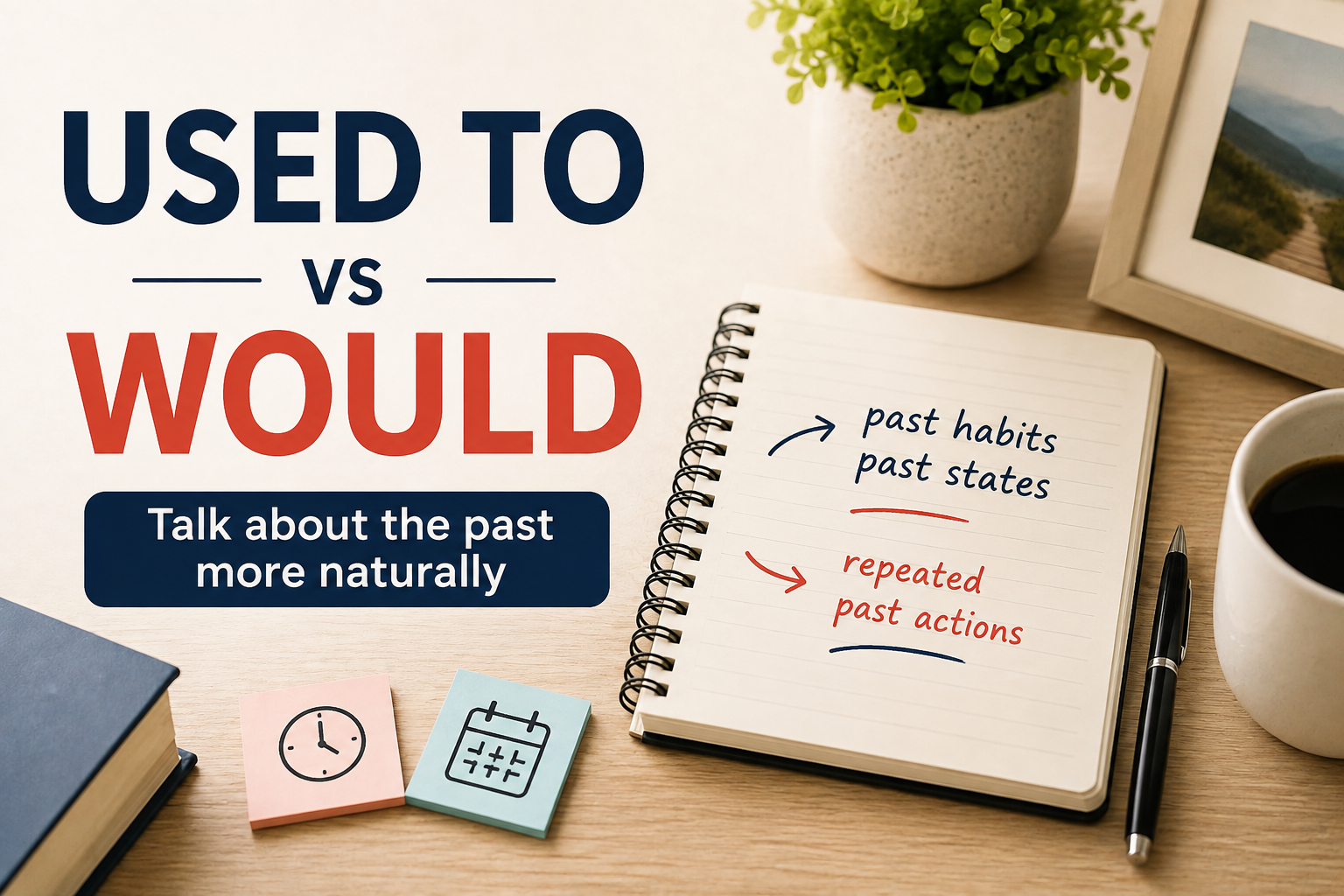
USED TO → past habits + past states
WOULD → repeated past actions
That second category — past states — is where the difference becomes especially important.
Why We Can’t Always Replace “Used To” With “Would”
Consider the sentence I used to be very shy. Here, being shy describes a state that was true in the past but is no longer true. We cannot simply replace used to with would and say I would be very shy to express the same idea. The sentence I would be very shy is grammatically possible in other contexts, but it does not normally mean that being shy was a past state that has now changed.
The same principle applies to sentences such as I used to have long hair, I used to love chocolate, or I used to believe that learning English meant memorising grammar rules. Having long hair, loving something, or believing something describe states rather than repeated actions. This is why used to works naturally in these sentences, while would does not normally replace it with the same meaning.
This often happens with verbs describing states, including be, have, know, believe, like, love, hate, want and understand. If you want to describe a state or situation that existed in the past but is no longer true, used to is generally the structure you need.
So When Should You Use “Would”?
Would becomes especially useful when you are telling a story or describing a repeated routine from the past. Imagine that you begin by saying: When I was a child, I used to spend my summers at my grandparents’ house. You have now established the past context, so you can continue: Every morning, my grandmother would make breakfast. Then my grandfather and I would go for a walk. In the afternoon, I would play outside with the other children.
Here, would gives the story a natural rhythm. Instead of repeatedly saying used to, you move through a series of actions that happened again and again within that period of your life. This is why would can be so effective in storytelling. It allows you to recreate a routine or repeated scene from the past: During the summer holidays, we would stay outside until late, or Whenever my friends came over, we would cook dinner together.
There is another important detail to remember. With would, we usually need enough past context for the listener to understand that we are describing a repeated past action. This might be something like when I was a child, when we lived in London, every summer, or whenever my friends came over. Without that context, would can sometimes be ambiguous because it has several other functions in English.
So, if you are unsure which structure to choose, used to is usually the safer option.
Why Does This Matter for Your Speaking?
Imagine an IELTS examiner asks you: What did you enjoy doing when you were a child?
You could answer: I played outside a lot. I visited my grandparents in summer. I liked reading. There is absolutely nothing grammatically wrong with this answer. The problem is that you are relying entirely on the Past Simple, so you are not showing much grammatical variety.
Now compare it with this answer:
I used to spend a lot of time outdoors when I was a child. During the summer, I would stay with my grandparents, and we would spend most evenings outside. I also used to be a huge bookworm, so whenever the weather was bad, I would stay indoors and read for hours.
The ideas themselves are not dramatically more complicated. What has changed is the range of grammatical structures used to express them. Instead of depending on one tense, you are moving naturally between the Past Simple, used to and would. This gives you more flexibility and allows you to express the relationship between past habits, past states and repeated actions much more precisely.
How “Used To” Helped Me in My IELTS Speaking Exam
This is something I discovered through my own experience as an English learner. Before becoming an English teacher, I had to go through exactly the same process my students go through today: learning grammar rules, doing exercises and then trying to make all that knowledge available when I actually spoke.
When I took my IELTS exam, I deliberately tried to bring used to into my Speaking answers whenever the topic naturally involved my childhood, previous habits or changes in my life. I remember using it quite a lot — probably a little too much! But I genuinely believe it helped me get some extra points. It allowed me to move beyond basic Past Simple sentences and demonstrate that I had different grammatical tools available when talking about the past.
There is a bigger lesson here that goes beyond used to and would. Knowing a grammar rule and being able to use it spontaneously are not the same thing. You can understand a structure perfectly when you see it in an exercise and still fail to retrieve it during a real conversation. That is why I don’t believe grammar practice should end when you get the exercise right. The real goal is to make the structure available when you actually need it.
How to Practise Used To and Would
A simple way to do this is to connect the grammar to your own life. Instead of creating random sentences just to practise the structure, think about what your life was actually like ten years ago. Where did you live? What did you believe? What did you enjoy? What were your weekends like? What habits have disappeared from your life?
Try completing sentences such as I used to live…, I used to be…, I used to have…, I used to think…, and I used to spend my weekends…. Then choose one of those ideas and expand it into a short memory using would for the repeated actions.
For example:
I used to spend my summers in the countryside. Every morning, I would get up early and go for a walk. In the afternoon, my friends and I would meet outside, and we would stay there until dinner.
Most importantly, don’t just write your answer. Say it out loud. The aim is to practise retrieving the grammar while speaking, rather than simply recognising it on the page. The more personally meaningful your examples are, the easier it becomes to associate the grammatical structure with the situations in which you actually need it.
Used To vs Would: The Rule to Remember
If all the details start to feel confusing, you really only need to remember one central distinction:
USED TO → past habits + past states
WOULD → repeated past actions
You can say I used to play tennis, because playing tennis was a past habit. You can also say I used to be shy or I used to have long hair, because used to can describe past states.
Would, on the other hand, works particularly well for repeated actions once the past context is clear: Every summer, we would go to the seaside. My grandmother would make dinner, and we would all eat together outside.
Understanding this distinction is useful, but understanding it is only the first step. The next time you talk about your childhood, your school years, an old job or a previous version of your life, deliberately try to use these structures.
Think of something that is no longer true and begin with I used to…. Then develop that memory with one or two sentences using would.
Because the real goal of learning grammar isn’t simply to know the rule.
It’s to have more ways to tell your story.