

Have you ever been speaking English and suddenly found yourself searching for a word? You know what you want to say, but you need a few seconds to remember the right expression, choose a verb form, or simply organise your thoughts. And then comes that awkward silence.
It’s a familiar experience for many English learners. We often associate fluency with speaking quickly and effortlessly, as though fluent speakers always have their next sentence ready. But that’s not how spontaneous conversation works.
Native speakers hesitate, correct themselves, change direction, and sometimes struggle to find the right words too. The difference is that they often use little words and expressions to manage these moments and keep the conversation moving.
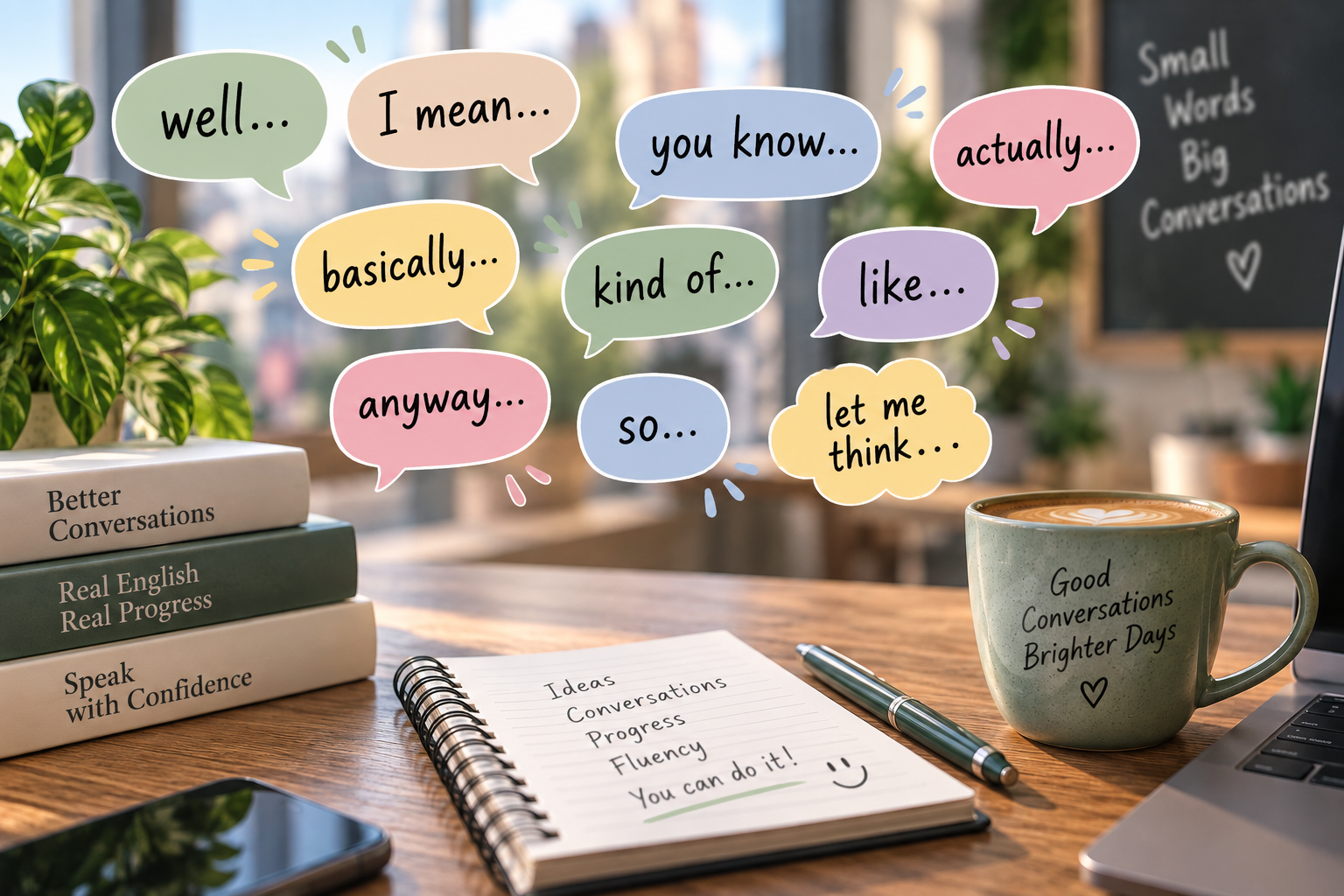
Think about how often you hear someone say well, I mean, you know, or let me think.
These expressions may seem insignificant, but they play an important role in natural spoken English. They can give us thinking time, help us clarify an idea, soften a statement, or signal that we’re returning to the main topic.
They’re commonly referred to as fillers, although some are more accurately described as discourse markers or conversational expressions.
Learning to use them appropriately can help you sound more natural and feel more comfortable during spontaneous conversations.
Let’s explore ten particularly useful expressions for B1–B2 learners.
Why do we use fillers in spoken English?
When we speak, we’re doing several things at once. We’re deciding what to say, retrieving vocabulary, constructing sentences, and paying attention to the person we’re talking to.
Unlike writing, speaking doesn’t usually give us the luxury of stopping to edit every sentence before producing it.
That’s where fillers and conversational expressions come in.
Some give us a moment to think. Others help us explain what we mean, correct something we’ve said, or move from one idea to another.
For example, imagine someone asks you whether you’d like to live abroad.
You might answer:
“Well, I’d love to, but I’d really miss my family.”
The word well gives you a moment to organise your answer. It also signals that your response isn’t going to be a straightforward yes or no.
Now imagine you’re describing your job:
“My job can be stressful. I mean, some weeks are absolutely hectic.”
Here, I mean introduces an explanation of your previous statement.
Both expressions contribute to the conversation, but they serve different purposes.
Understanding these differences is essential. The goal isn’t to memorise a list of fillers and insert them randomly into your speech. It’s to learn what each expression does and recognise the situations in which it sounds natural.
Buying yourself thinking time: Well, so, and let me think
One of the most useful things you can learn as an English speaker is how to manage the time between hearing a question and producing your answer.
You don’t need to respond immediately, especially when the question requires some thought.
Well is particularly useful at the beginning of an answer that isn’t completely straightforward.
Imagine someone asks:
“Do you enjoy cooking?”
You could respond:
“Well, I enjoy it when I have enough time.”
The word well gives you a moment to think and makes the response sound less abrupt.
Another common expression is so.
You probably already know so as a conjunction expressing a result, as in “I was tired, so I went home.” However, it also has a conversational function.
We often use it to introduce an explanation or begin a longer answer.
For example:
“Why did you start learning English?”
“So, I originally started learning English because I needed it for work.”
In this case, so helps the speaker introduce and organise the explanation that follows.
Sometimes, however, we need more than a brief moment. Perhaps someone has asked us a question and we genuinely need time to remember something.
That’s when let me think becomes especially useful.
Imagine someone asks you about the best film you’ve seen this year. You can’t immediately remember the title, so you say:
“Let me think… Oh, I really enjoyed…”
This expression explicitly tells the listener that you’re considering your answer.
And there’s an important lesson here for English learners: you don’t have to produce every answer immediately to be a fluent speaker.
Sometimes you need time to retrieve a word or organise your thoughts. Knowing how to manage that time is part of effective communication.
Clarifying your ideas: I mean and basically
Have you ever started explaining something in English and realised that your first sentence didn’t quite express what you wanted to say?
It happens all the time, even in our native languages.
Fortunately, spoken English gives us several ways to clarify or reformulate our ideas without stopping the conversation.
One of the most useful is I mean.
Consider this example:
“My job can be stressful. I mean, some weeks are absolutely hectic.”
The speaker makes a general statement and then adds more information to explain it.
We can also use I mean when correcting ourselves:
“It happened on Friday… I mean, Saturday.”
Instead of starting the sentence again, we simply correct the information and continue.
Another useful expression is basically, which helps us simplify an explanation or communicate its essential meaning.
Imagine someone asks you what you do for a living.
You could explain every aspect of your job in detail, or you could say:
“Basically, I help companies solve technical problems.”
The word basically signals that you’re giving the main idea rather than a complete explanation.
It’s particularly useful when discussing complicated subjects, describing your work, or summarising a situation.
Both I mean and basically help us communicate more effectively, but they do so in different ways. While I mean often introduces clarification or correction, basically helps us simplify information.
Making your English less direct: Kind of and like
Natural conversation isn’t always about being completely precise.
Sometimes we want to soften a statement, describe something approximately, or avoid sounding too definite.
Two useful expressions for doing this are kind of and like.
In informal spoken English, kind of often makes a description less strong or less precise.
Compare these sentences:
“I was disappointed.”
“I was kind of disappointed.”
The first statement is direct. The second suggests that the speaker was disappointed to some extent, but perhaps not extremely so.
We commonly use kind of before adjectives:
“I’m kind of tired.”
“It’s kind of strange.”
“It was kind of awkward.”
This expression is particularly useful when describing feelings, opinions, and experiences that aren’t easy to define precisely.
Like, on the other hand, has several functions in informal conversation.
One of them is expressing approximation.
For example:
“There were, like, thirty people waiting.”
The speaker isn’t necessarily saying that exactly thirty people were there. The number is approximate.
Similarly:
“It took me, like, two hours.”
Here, like has a meaning similar to about or approximately.
You may also notice that some speakers use like as a hesitation filler while they’re thinking.
It’s very common in informal English, but it’s worth being selective about how often you use it. Adding like to every sentence won’t automatically make your speech more fluent.
The aim is to understand its function and use it when it contributes naturally to what you’re saying.
Connecting with your listener: You know
Conversation isn’t simply about producing grammatically correct sentences. It’s also about creating a connection with the person you’re speaking to.
One expression that helps us do this is you know.
Imagine someone describing a particularly exhausting day:
“I was completely exhausted. You know, that feeling when you just want to go home and do nothing?”
Here, the speaker is inviting the listener to recognise or relate to the experience.
It’s almost like asking, “Do you understand what I mean? Have you experienced this too?”
You know can also give us a little thinking time while we continue speaking.
However, as with other fillers, moderation matters. If you use it every few seconds, it can become a habit rather than a useful conversational tool.
Try listening to native speakers in interviews or podcasts. Notice when they use you know to involve the listener or refer to shared experiences.
Correcting assumptions: Actually
Another extremely useful conversational expression is actually.
We often use it when introducing information that may be unexpected or different from what the other person assumes.
Imagine someone asks:
“Do you drink coffee?”
You reply:
“Actually, I don’t. I prefer tea.”
The word actually signals that your answer may be different from what the listener expected.
We can also use it to correct information we’ve just given:
“I moved here five years ago — actually, it’ll be six years in October.”
For Italian speakers, there’s an important distinction to remember.
Actually doesn’t mean attualmente.
It means something closer to in fact or in realtà.
If you want to say attualmente, you can use currently or at the moment.
This is a common source of confusion, so it’s worth paying attention to how actually is used in real conversations.
Keeping the conversation moving: Anyway
Have you ever been telling a story and suddenly found yourself talking about something completely different?
Perhaps you started describing your holiday, mentioned a restaurant, and then spent several minutes talking about food.
Eventually, you want to return to your original story.
That’s where anyway comes in.
For example:
“We stopped for a coffee and ended up talking for about an hour. Anyway, eventually we got back in the car and continued our journey.”
Here, anyway signals that the speaker is returning to the main narrative.
It’s also useful when you want to move a conversation forward, change direction, or bring a topic to a close.
This makes it particularly valuable when telling stories, describing experiences, or participating in longer conversations.
Rather than stopping abruptly or struggling to find a way back to your original point, you can use anyway to make the transition more natural.
Can using too many fillers make your English sound less natural?
Absolutely.
Although fillers can help your English sound more natural, using them excessively can have the opposite effect.
Imagine someone answering a question like this:
“Well, you know, I basically, like, kind of wanted to, you know, change jobs, so, I mean…”
The message becomes difficult to follow because the fillers are taking over.
The purpose of these expressions is to support your communication, not replace it.
And not every pause needs to be filled. A brief silence is a perfectly normal part of conversation.
It’s also important to remember that different expressions have different functions. Well and let me think can give you thinking time, while I mean helps you clarify an idea. Basically simplifies an explanation, and anyway helps you return to the main topic.
Learning to choose the right expression for the situation is far more useful than trying to include as many fillers as possible.
How can you make these expressions part of your active vocabulary?
Recognising fillers when you hear them is a good starting point, but recognition alone doesn’t mean you’ll be able to use them spontaneously.
To make these expressions part of your spoken English, you need to practise retrieving and producing them.
Start by choosing just two or three expressions.
For example, you could focus on well, I mean, and actually.
Think of situations in which you might naturally use them. Then answer personal questions aloud, deliberately practising the expressions in context.
You could describe your job and use I mean to clarify something. You could answer a question about your future plans using well, or correct a common assumption about yourself using actually.
The more personally relevant your examples are, the more opportunities you’ll have to use the expressions in real conversations.
It’s also worth paying attention to authentic spoken English.
The next time you watch an interview, listen to a podcast, or follow a conversation in a film or TV series, notice the little words that speakers use around their main message.
Listen for expressions such as well, you know, I mean, and anyway.
Ask yourself why the speaker used that particular expression. Were they thinking, clarifying, softening a statement, or returning to an earlier point?
Understanding the function behind the expression will help you use it more appropriately yourself.
Practise with free B1–B2 worksheets
If you’d like to put these expressions into practice, I’ve prepared two worksheets designed to help you move from understanding conversational expressions to using them in your own spoken English.
Worksheet 1: 10 English Fillers You’ll Actually Use | B1–B2
This worksheet focuses on the ten expressions covered in this article. You’ll practise recognising their functions, completing natural conversations, rewriting sentences, and answering personalised speaking questions.
Download Worksheet 1 — Link
Worksheet 2: More English Fillers You’ll Actually Use | B1–B2
Ready to expand your conversational vocabulary? This second worksheet introduces 15 additional expressions, including to be honest, I suppose, the thing is, to be fair, and by the way.
It includes practical exercises and speaking activities to help you use these expressions in everyday situations.
Download Worksheet 2 — Link
You can also watch my YouTube lesson, 10 English Fillers That Make You Sound More Natural, to hear the expressions in context and practise using them with me.
Watch the video — YouTube link
Final thoughts
Fluency isn’t about speaking without pauses or having every word ready the moment someone asks you a question.
It’s about communicating your ideas effectively, even when you need time to think, clarify something, or change direction.
Little expressions such as well, I mean, actually, and let me think can help you do exactly that.
Start noticing them in real conversations, practise using them in situations that are meaningful to you, and gradually make them part of your active vocabulary.
Remember: natural English isn’t about filling every silence. It’s about knowing what to say when you need a moment to think.