Are You Drowning in English Content?
Have you ever opened Instagram or YouTube intending to spend just a few minutes improving your English, only to find yourself scrolling through dozens of vocabulary videos, grammar tips, and language-learning reels?
If so, you’re not alone.
Today’s English learners have access to more resources than ever before. Every day, social media platforms are flooded with content promising to help you sound more fluent, learn faster, or speak like a native speaker. A quick scroll can expose you to lists of phrasal verbs, advanced vocabulary, slang expressions, idioms, pronunciation tips, and grammar shortcuts. The sheer amount of information available is astonishing.
At first glance, this seems like a wonderful thing. After all, having access to so many learning materials should make learning easier, shouldn’t it?
Not necessarily.
The reality is that many learners feel more overwhelmed than ever. Instead of feeling confident and making steady progress, they often feel as though they’re constantly chasing the next piece of information without truly mastering what they’ve already learned.
Take social media, for example. It is full of reels explaining trendy expressions such as to yap, spill the tea, or delulu. These expressions can be entertaining, and understanding modern slang certainly has its place. However, if you still struggle to explain your opinion during a conversation, describe what happened during your day, or tell a simple story in English, are these really the words you need to focus on right now?
For many learners, the answer is probably no.
And that brings us to one of the biggest challenges of modern language learning: learning how to separate useful information from distracting information.
The Problem with Modern Language Learning
We live in an age of unlimited information. No matter what aspect of English you want to improve, there is an endless supply of content available at your fingertips.
Want to learn phrasal verbs? Thousands of videos are waiting for you.
Need grammar explanations? You can find hundreds of them within seconds.
Looking for vocabulary? There are entire accounts dedicated to posting new words every single day.
The problem is that while the amount of information available has increased dramatically, our capacity to process and remember that information has not.
Our brains still need time to absorb, organise, and consolidate what we learn. We still need repetition. We still need meaningful exposure. And perhaps most importantly, we still need time.
Unfortunately, time is something many adult learners have very little of.
Between work, family responsibilities, studies, and everyday commitments, most people cannot spend several hours a day actively studying English. As a result, they often look for quick solutions. Short reels and bite-sized content seem like the perfect answer.
The problem is that consuming information is not the same as learning it.
Many learners spend hours watching educational content. They save posts, bookmark videos, and collect vocabulary lists. At the end of the day, they feel productive because they have been exposed to a large amount of English.
However, when they try to use that language a few days later, much of it has already disappeared from memory.
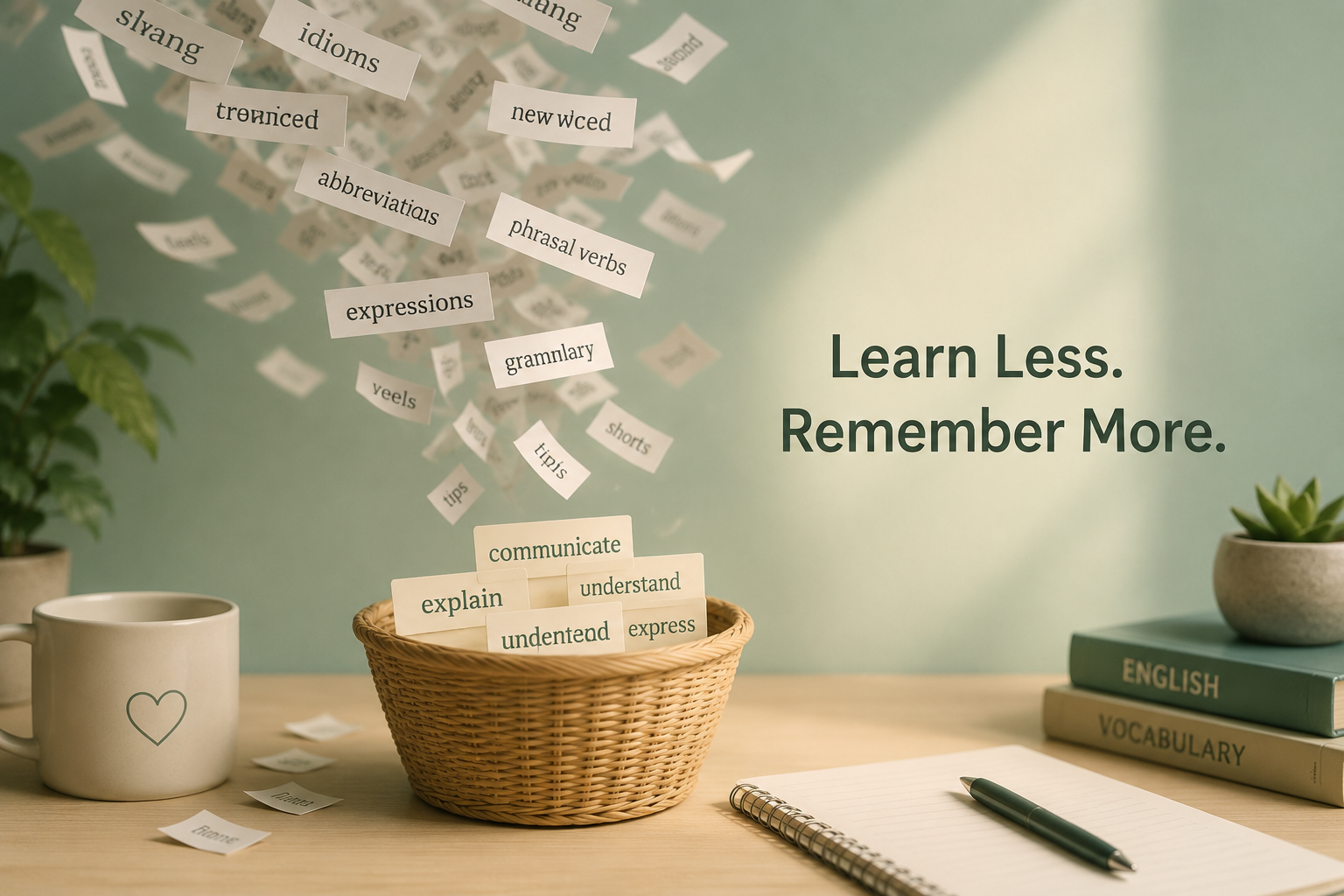
This creates a frustrating cycle. Learners continue searching for more content, believing that the solution is to learn more words, when in reality the solution may be to learn fewer words more effectively.
The Illusion of Progress
One of the most deceptive aspects of language learning is what I like to call the illusion of progress.
Imagine watching a short video that teaches three new expressions. You understand the explanations immediately. The examples make sense. You even think to yourself, “That’s useful. I’ll remember that.”
At that moment, it genuinely feels as though you’ve learned something.
The problem is that understanding an expression when somebody else explains it to you is only the first step in the learning process.
A few days later, you may recognise that same expression if you see it again. Because it looks familiar, your brain assumes that you know it. This feeling of familiarity can be misleading.
Recognition and mastery are not the same thing.
You may recognise a phrase when reading an article or watching a video, yet still be unable to use it naturally in conversation. You may understand its meaning but hesitate when trying to include it in a sentence of your own.
True vocabulary acquisition requires much more than simple exposure.
To move a word from passive recognition to active use, learners need repeated encounters with that word in different contexts. They need opportunities to retrieve it from memory, use it in meaningful situations, and connect it to ideas that matter to them personally.
Without repetition, context, retrieval, and meaningful use, vocabulary often passes through the mind like water through a sieve. It enters quickly, but it doesn’t stay there for long.
The result is a feeling that you’re constantly learning but rarely progressing.
And that feeling can be incredibly discouraging.