Have you ever come across one of those vocabulary lists that promises to make your English sound more advanced? You know the kind: “Don’t say happy, say ecstatic,” “Don’t say sad, say miserable,” “Don’t say big, say enormous.” It can be tempting to save these lists and start memorising them, especially when you’re working towards a higher level of English. After all, if a word is labelled C1 or C2, it must be better than a B1 or B2 word, right?
Not necessarily.
If you’ve ever spent hours learning sophisticated vocabulary only to find that you almost never use it when you actually speak English, you’re not alone. Many learners assume that fluency means knowing thousands of difficult words. But speaking fluent English isn’t simply about how many advanced words you know. It’s about having a wide range of useful language and knowing how to use it naturally and appropriately.
Of course, there are situations where advanced vocabulary is extremely useful. If you’re preparing for a C2 exam, writing academic essays, producing formal reports, or working with specialised texts, learning higher-level vocabulary is an important part of your preparation. But if your main goal is to communicate naturally and confidently in everyday situations, spending most of your time memorising obscure C2 words may not be the best use of your energy.
A strong B2 level can take you a long way
Personally, I believe that a strong B2 level bordering on C1 provides an excellent foundation for fluent everyday communication. At this level, you can already express complex ideas, explain your opinions, understand most conversations, communicate accurately and use a wide range of vocabulary without constantly searching for a more sophisticated word.
In fact, someone with a strong B2 level may already have many of the skills and much of the vocabulary needed to successfully work towards a C1 exam. The difference between B2 and C1 isn’t simply a list of more difficult words. It also involves greater accuracy, flexibility, range, control and the ability to use language appropriately in different contexts.
C2 is another step beyond this. A significant amount of C2 vocabulary is particularly useful in academic writing, formal publications, research and highly specialised discussions. That doesn’t make these words “better” than everyday vocabulary. They simply have different purposes.
Think about the English you hear in interviews, podcasts or television programmes. Native speakers aren’t constantly trying to impress each other with sophisticated C2 vocabulary. They use common words, natural expressions, conversational phrases and everyday grammar. Yet they sound fluent.
Why? They aren’t trying to impress anyone with sophisticated vocabulary. They’re choosing the words that fit the situation naturally.
The problem with “vocabulary upgrades”
This leads to another common problem: the idea that every basic English word has a more advanced equivalent that you can simply substitute for it.
You might think, “If I replace a simple word with a C1 or C2 word, my English will automatically sound more advanced.” Unfortunately, language doesn’t work quite that way.
Advanced words are often not direct synonyms of simpler words. Even when two words have a similar basic meaning, they may differ in strength, emotional meaning, typical context or the words they naturally occur with. This is why simply finding a more advanced synonym isn’t always the best way to improve your vocabulary.
I experienced this myself when I created a vocabulary upgrade suggesting miserable as an alternative to sad. A native speaker saw it and told me that it was wrong. At first, I disagreed. After all, miserable can mean very unhappy, so it clearly has a connection with sad. But after thinking about the comment, I realised that there was an important point behind it.
The issue wasn’t really the dictionary definition. The issue was context and intensity.
Consider the sentence:
I’m sad because my favourite TV series ended.
This sounds completely natural. Now compare it with:
I’m miserable because my favourite TV series ended.
The second sentence is grammatically correct, but it sounds much stronger and could easily sound exaggerated in this context. Miserable usually suggests a much deeper or more intense feeling of unhappiness.
The difference becomes even clearer here:
She felt sad after the argument.
This simply tells us that she was unhappy. But:
She felt miserable after the argument.
suggests that she was suffering much more deeply.
At the same time, there are contexts where miserable is exactly the right word. For example:
The weather was miserable all week.
Here, the word sounds completely natural.
So the problem isn’t that miserable is “wrong”. It’s that it isn’t always an appropriate replacement for sad. When you learn a new word, you need to understand not only what it means, but also how strong it is, when people use it and what kind of context it belongs to.
That’s what real vocabulary knowledge looks like.
So what should you learn?
If replacing every basic word with a more sophisticated one isn’t the answer, what should you focus on instead? I would focus on language that gives you more control over what you say. You want to be able to express yourself naturally, connect your ideas, add nuance and choose an expression that fits the situation.
One of the most useful areas to focus on is collocations.
A collocation is a combination of words that naturally go together. You may know the individual words make, decision, heavy and rain, but fluent speakers know that English normally combines them in particular ways: make a decision, heavy rain, strongly recommend, highly unlikely and considerably better.
Notice that you don’t need particularly difficult vocabulary to create these expressions. Make, decision, heavy, rain are all common words. However, putting them together in the way English speakers naturally do makes your language sound much more accurate and natural.
The same principle applies when you’re learning more advanced vocabulary. Learning significant = important is a good start, but don’t stop with the definition. Notice how the word is actually used: a significant difference, a significant increase, a significant improvement. Learning these combinations gives you a much better understanding of how the word works and makes it easier to use it yourself.
This is one of the biggest differences between knowing a word and being able to use a word.
Learn chunks, not just individual words
Another useful area is chunks of language: groups of words that you can learn and use together rather than constructing everything from individual words every time you speak.
Think about expressions such as The thing is…, What I mean is…, It turns out that…, As far as I’m concerned…, There’s no point in… and I wouldn’t say that….
These expressions give you ready-made structures for communicating your ideas. For example, instead of trying to build an explanation from scratch, you can start with The thing is… and then add your main point:
The thing is, I don’t really have enough time.
Fluent speakers can often sound effortless because they have many of these pieces of language stored and ready to use. They aren’t necessarily creating every sentence from scratch. They have a large collection of familiar expressions, patterns and combinations that they can draw on quickly.
For a learner, this can be much more useful than memorising a long list of isolated C2 words.
Use conversational language
Another area learners often underestimate is conversational language.
When we learn English from textbooks, conversations can sometimes sound very neat and organised. You might learn expressions such as “In my opinion…”, “I think that…” or “I disagree with you because…”. These are perfectly correct, but real conversations are usually much less organised.
People hesitate. They think while they’re speaking. They change direction, clarify what they mean, soften what they’re saying and give themselves time to think. This is why you’ll constantly hear expressions such as well, so, I mean, you know, kind of, sort of, actually, anyway and like.
For example:
Well, I mean, it’s kind of difficult to explain.
I don’t know. It’s sort of complicated.
Actually, I think you’re right.
So, what happened next?
These expressions don’t necessarily make your vocabulary more advanced. They make your English sound more conversational. And if your goal is to communicate naturally, that is extremely valuable.
Add nuance with precise adverbs
Finally, I recommend paying attention to precise adverbs. These can help you express your meaning more accurately without forcing you to search for obscure vocabulary.
Compare:
My English has improved a lot.
with:
My English has improved considerably.
Or:
The situation has changed a lot.
with:
The situation has changed significantly.
You can also add precision with words such as definitely, certainly, particularly, relatively and increasingly.
For example:
I particularly enjoyed the final episode.
sounds more precise than simply:
I really enjoyed the final episode.
The important thing is not to learn these words as isolated synonyms. Learn them together with the words and expressions they naturally occur with. For example, you might learn considerably better, considerably more difficult and improve considerably, rather than simply memorising considerably = a lot.
When I was preparing for my Cambridge C2 Proficiency exam, I created a list of useful adverbs together with the adjectives and expressions they commonly occurred with. Many of these collocations came from the Proficiency preparation book I was using.
I’ve put this list together for you too, so you can use it to expand your vocabulary in a more practical way. You can download the list from my website.
Knowing a word isn’t enough
There’s one more thing to remember: knowing an advanced word is one thing; using it naturally is another.
This is particularly important with adverbs. For example, we say:
I definitely recommend this book.
She certainly knows what she’s doing.
I particularly enjoyed the final episode.
My English has improved considerably.
The number of students has increased significantly.
Notice that these adverbs don’t all behave in exactly the same way. Their position in the sentence and the words they combine with are part of knowing the word.
So when you learn a new word, don’t only ask, “What does it mean?” Also ask yourself: “Where does it go in a sentence?” “What words does it commonly occur with?” and “In what situations would I actually use it?”
These questions will help you turn passive vocabulary into language you can actively use.
What does “advanced English” really mean?
So, what should you take away from all of this?
You don’t need to fill your English with complicated C2 words to sound fluent or advanced. What matters much more is having a wide range of useful language and knowing how to use it appropriately.
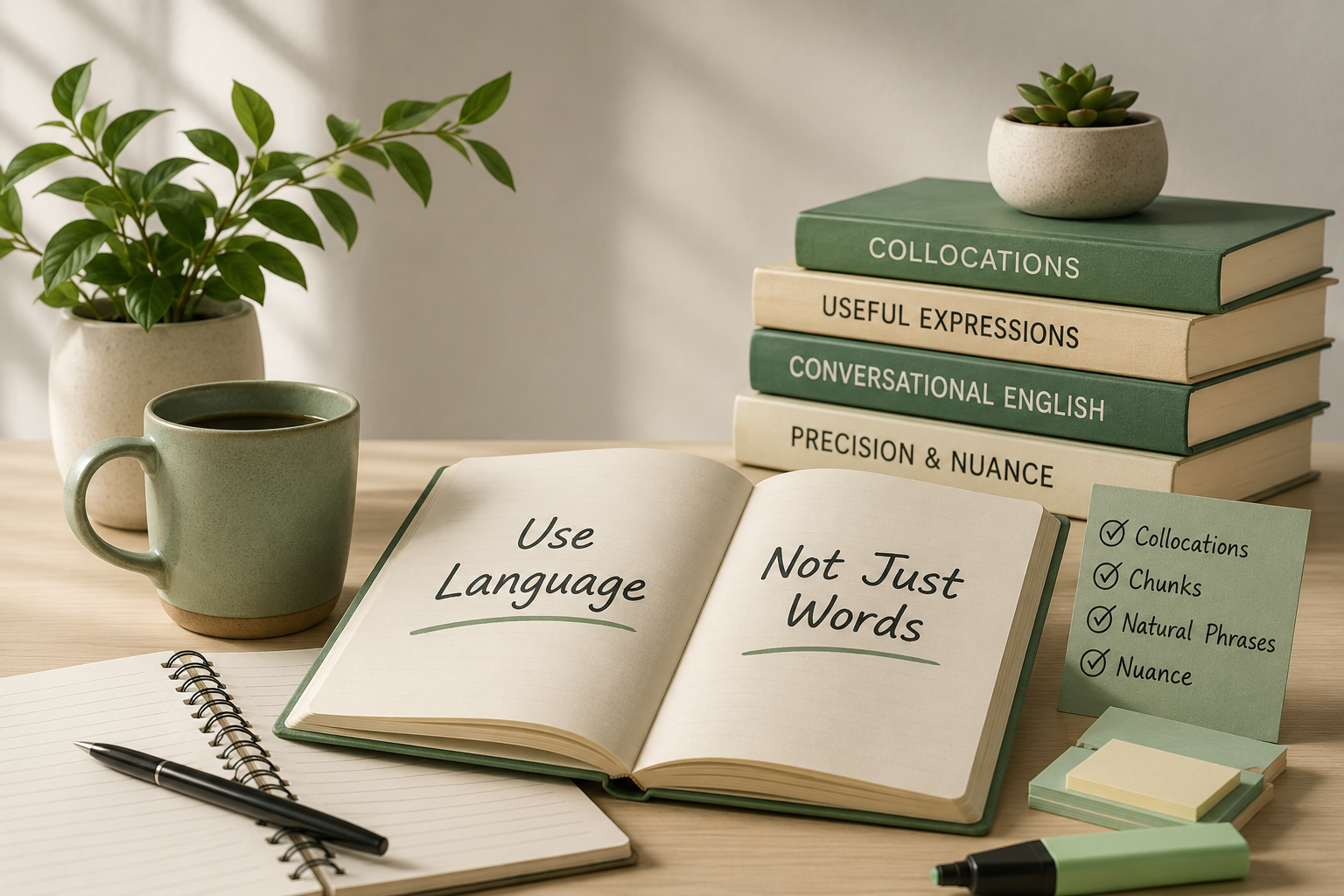
Learn synonyms, but learn their strength and context too. Learn collocations, chunks, conversational expressions and precise adverbs. And most importantly, don’t learn a word simply because someone has labelled it C1 or C2.
Learn it because you can actually use it.
Knowing a difficult word and being able to use it naturally are two very different things. And sometimes, choosing a simple word that fits perfectly is a much more advanced skill than using a complicated word that doesn’t.