If you’re trying to improve your spoken English, you may feel that the solution is to learn more words — preferably more advanced ones. The more sophisticated your vocabulary, the better your English will sound. At least, that’s the idea.
But having a large vocabulary doesn’t necessarily mean that those words will be available when you need them in a conversation.
Speaking requires you to retrieve language quickly. And one way to make that process easier is to stop thinking only in individual words and start learning chunks of language.
Chunks are combinations of words that frequently occur together and that we can learn and retrieve as a whole. Instead of constructing every sentence word by word, you have ready-made pieces of language that you can adapt to different situations.
Think about an expression like I tend to…. Once this combination becomes familiar, you don’t need to build it from scratch every time. You simply retrieve the chunk and complete the idea:
I tend to go to bed late.
I tend to overthink things.
I tend to spend more money when I’m travelling.
The vocabulary itself isn’t particularly advanced. What makes the chunk valuable is how easily it can be reused.
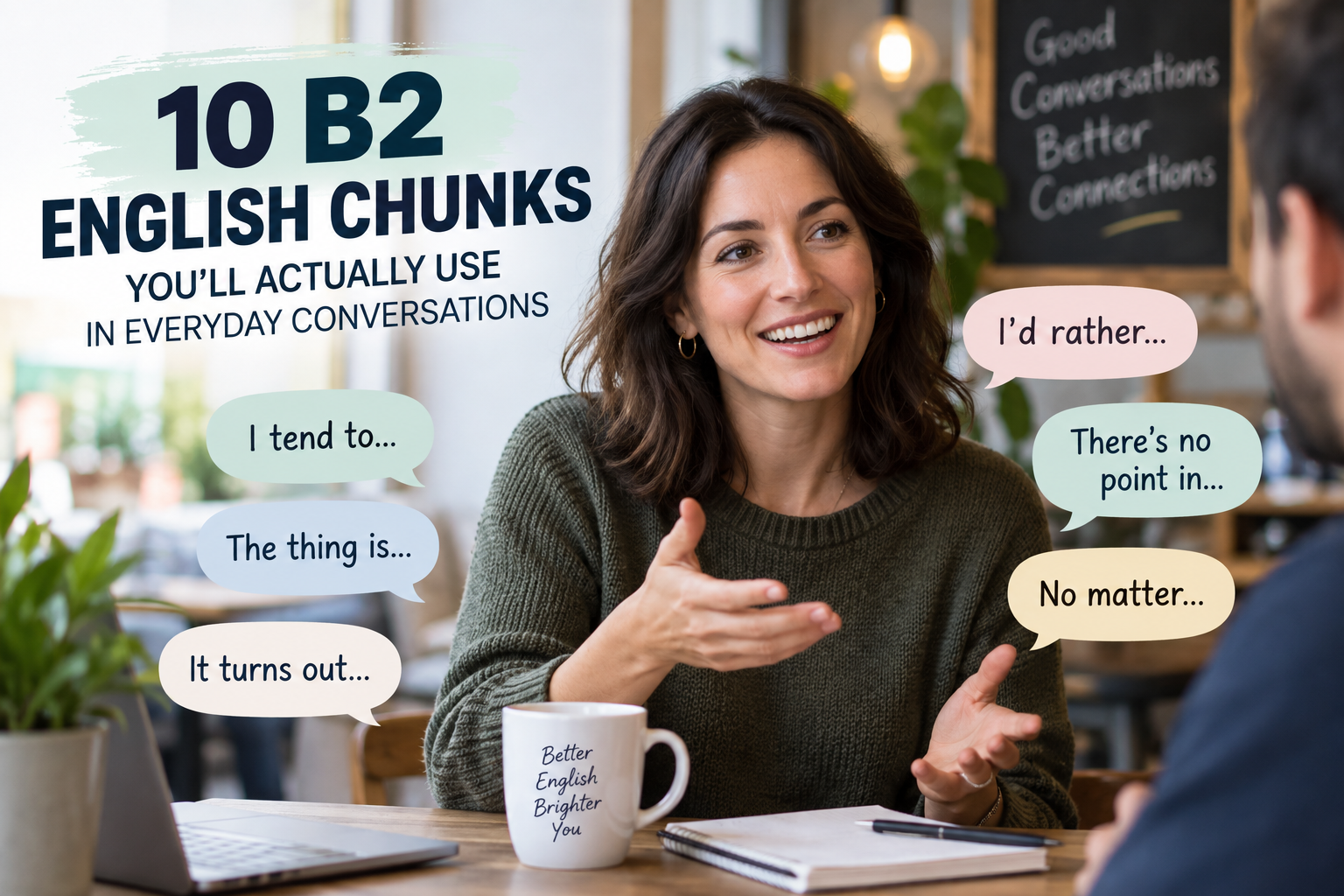
Here are ten B2 chunks that can help you do exactly that.
- I tend to…
If you constantly use usually to talk about your habits, I tend to… gives you another very natural way to describe what you generally do.
You might say:
I tend to drink more coffee when I’m busy.
I tend to stay at home on Sunday evenings.
The pattern is I tend to + base verb, which makes it extremely easy to adapt. Think about your own behaviour when you’re tired, stressed, busy or on holiday. What do you tend to do?
The more personally relevant your answer is, the more useful the chunk becomes.
- When it comes to…
Conversations often move from a general topic to one particular aspect of it. When it comes to… is a useful way of making that transition.
When it comes to money, I’m quite careful.
When it comes to cooking, I’m pretty good.
When it comes to choosing a holiday destination, I usually prefer somewhere by the sea.
The expression is followed by a noun or an -ing form: when it comes to work, when it comes to relationships, when it comes to learning English.
It’s particularly useful because it can introduce almost any topic. Try completing this sentence with something that describes you:
When it comes to ______, I’m ______.
- I’m not used to…
Starting a new job, moving to another country, changing your routine or simply waking up much earlier than usual all have something in common: you need time to adapt.
That’s where I’m not used to… becomes useful.
I’m not used to getting up at six.
I’m not used to this kind of weather.
I’m not used to speaking in front of large groups.
There’s an important structural detail here. The to in be used to is followed by a noun or an -ing form, not an infinitive. So we say I’m not used to driving in heavy traffic, not I’m not used to drive in heavy traffic.
What has changed in your life recently that you’re still not used to?
- I’d rather…
Everyday conversations are full of choices: stay in or go out, drive or take the train, talk now or wait until tomorrow.
Instead of always saying I prefer, try I’d rather…
I’d rather stay at home tonight.
I’d rather wait until tomorrow.
I’d rather talk about it in person.
The structure is I’d rather + base verb, without to. So it’s I’d rather stay, not I’d rather to stay.
Because preferences come up constantly in conversation, this is one of those chunks that can quickly become part of your active English.
- It’s worth…
When you recommend a film, restaurant, book, place or experience, it’s worth… is extremely useful.
That film is definitely worth seeing.
This book is worth reading.
If you’re in Barcelona, Park Güell is worth visiting.
After worth, use a noun or an -ing form: It’s worth the money. It’s worth trying.
Think about where you live. If a friend came to visit tomorrow, what would you tell them is worth seeing, visiting or trying?
- There’s no point in…
Sometimes the opposite is true: an action simply isn’t going to help.
There’s no point in… allows you to express exactly that.
There’s no point in worrying about something you can’t change.
There’s no point in arguing about it.
There’s no point in buying a new phone if yours works perfectly well.
The expression is followed by an -ing form: there’s no point in + doing something.
It’s useful for giving advice, expressing opinions and talking about situations where an action seems unnecessary or ineffective.
- The thing is…
Not every useful chunk has a complicated grammatical structure. Some are valuable because they help you manage a conversation.
The thing is… is a perfect example.
Imagine someone asks why you don’t come out more often:
I’d love to. The thing is, I have to work most weekends.
Or someone asks why you don’t buy something:
The thing is, I don’t really need it.
It introduces an explanation, complication or important detail. And there’s another advantage: it gives you a moment to organise the rest of your answer while keeping the conversation moving.
That’s a useful skill when you’re speaking a foreign language.
- No matter…
No matter becomes particularly useful when combined with words such as what, where, who, when and how.
No matter what happens, I’ll be there.
No matter where I go, I always miss home.
No matter how tired I am, I try to exercise.
These combinations allow you to say that something remains true despite changing circumstances.
You can learn them as reusable frames: no matter what happens, no matter where I go, no matter how difficult it is, no matter how much it costs.
Then complete them with information that is relevant to your own life.
- I have a hard time…
Being able to talk about difficulties is useful in almost any conversation, and I have a hard time… gives you a natural way to do it.
I have a hard time remembering people’s names.
I have a hard time concentrating when there’s noise around me.
I have a hard time saying no to people.
The expression is followed by an -ing form.
And it’s particularly relevant when talking about language learning. Ask yourself:
When I speak English, what do I have a hard time doing?
Perhaps it’s finding the right word, understanding fast speech or remembering vocabulary. Your answer gives you not only a personalised example of the chunk, but also a useful clue about what you need to practise.
- It turns out (that)…
We often start a story believing one thing and finish it having discovered something completely different. It turns out… is perfect for those situations.
I thought the restaurant was closed, but it turns out it was open.
I thought I’d lost my keys, but it turns out they were in my bag.
We started talking, and it turns out that we went to the same school.
In informal conversation, that is often omitted, so both it turns out that… and it turns out… are useful patterns to recognise and use.
It’s a particularly good chunk for storytelling because it allows you to introduce an unexpected discovery or result naturally.
Knowing a chunk isn’t the same as being able to use it
Now you’ve seen ten useful chunks. But there’s an important question: will they actually come to mind the next time you’re speaking English?
Simply reading them — or even understanding them perfectly — doesn’t guarantee that they will.
This is where personalisation becomes important.
Instead of memorising:
I tend to drink too much coffee.
learn the reusable frame:
I tend to + verb
Then connect it to different things in your own life:
I tend to wake up early.
I tend to worry too much.
I tend to spend more money when I’m travelling.
You’re no longer trying to remember one sentence. You’re practising a piece of language that can help you produce many different sentences.
The same principle applies to all the chunks in this article.
Choose the ones that are relevant to you. Create your own examples. Say them aloud. Then use the same chunk again with a different idea.
The goal is to move from recognising the language to retrieving it.
Ready to put these chunks into use?
If you want to practise the ten chunks from this article, I’ve created a worksheet specifically for them. It will help you practise the structures, retrieve the chunks in different situations and, most importantly, personalise them.
You can also download my B2 Chunk Bank for Everyday Conversations, which contains 30 additional B2 chunks that you can use to express opinions, talk about yourself, explain your ideas, discuss preferences and react naturally in conversation.
You don’t need to learn them all at once. In fact, you shouldn’t.
Choose the language that fits your life and the conversations you actually have, and work on making it available when you need it.
Because the goal isn’t to collect more English.
It’s to be able to use the English you know when you actually need to speak.