Someone asks you, “How was your weekend?” and you reply, “It was good. I stayed at home and relaxed.” There’s absolutely nothing wrong with that answer. It’s grammatically correct, clear and perfectly understandable. But perhaps you’d like to make your English sound a little more natural, varied and expressive.
The good news is that you don’t need to have done anything particularly exciting to have something interesting to say. Even a quiet weekend spent at home can give you plenty to talk about. Often, it’s simply a matter of knowing the right expressions and learning how to use them. A few well-chosen phrases can help you describe your experiences more precisely, express how you felt and keep a conversation going without having to rely on complicated grammar.
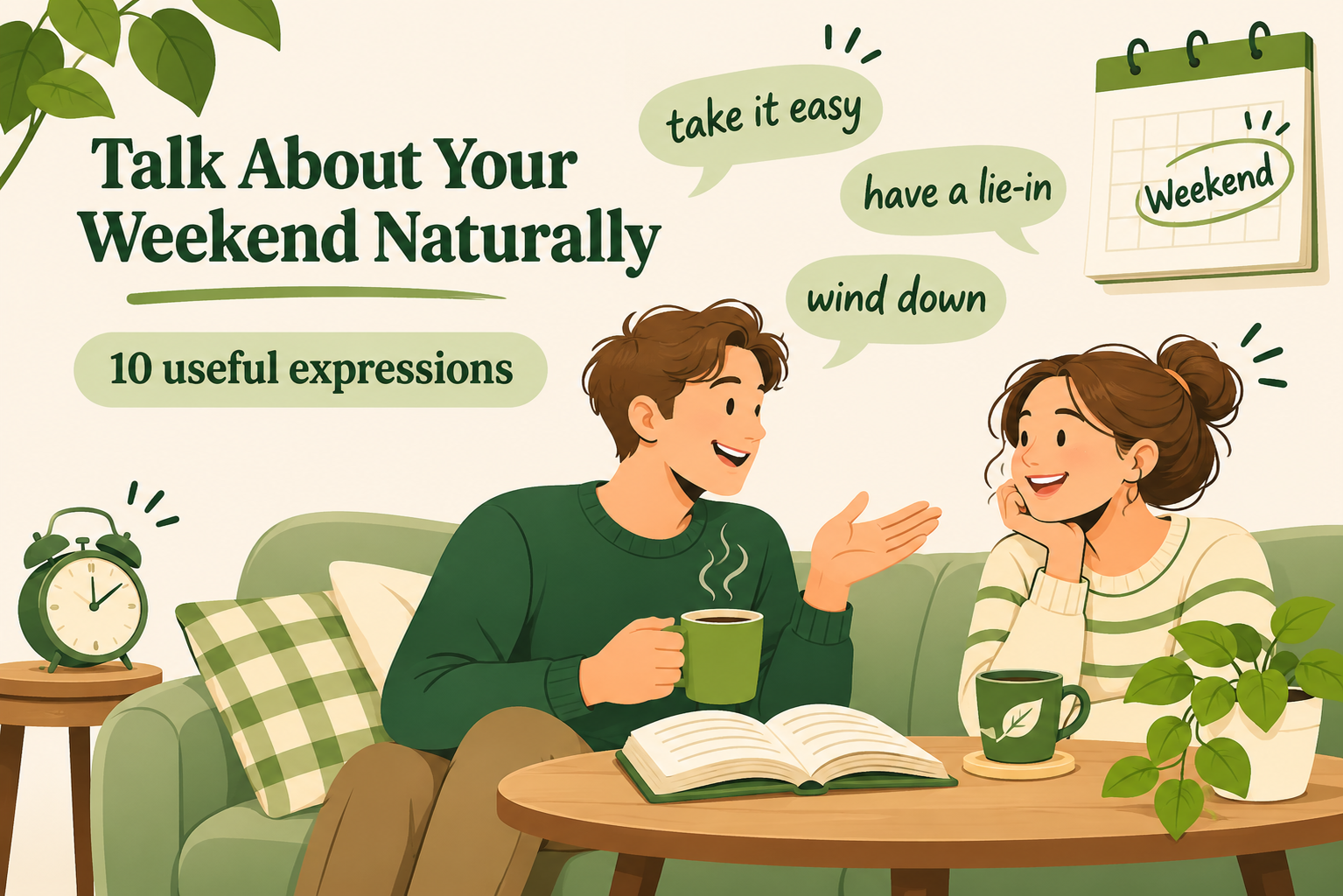
In this article, we’ll explore 10 useful English expressions for talking about your weekend and free time, look at some important differences between similar expressions, and discover how to combine them to give natural answers in everyday conversations. You’ll also have an opportunity to practise building your own responses.
1. Take it easy
To take it easy means to relax, avoid doing anything too demanding and enjoy a slower pace. It’s particularly useful when you’ve had a busy week and want to spend some time doing very little. Perhaps you stayed at home, watched a film, read a book or simply enjoyed not having any particular plans. Instead of listing everything you didn’t do, you can sum up your weekend by saying that you took it easy.
For example:
“I didn’t do much on Saturday. I just took it easy.”
“After such a busy week, I decided to take it easy over the weekend.”
You can use this expression even if you did a few things during the day. The important idea is that you weren’t rushing around or putting yourself under pressure. It’s a natural, conversational way to explain that you chose to relax rather than fill your free time with activities.
2. Have a lie-in
To have a lie-in is a common British English expression meaning to stay in bed longer than usual in the morning, especially when you don’t have to get up early. For many people, one of the nicest things about the weekend is not having to set an alarm or rush out of the house. If you enjoy sleeping a little longer on your days off, this is an expression you’ll probably find yourself using quite often.
For example:
“I had a lovely lie-in on Sunday.”
“It was so nice not having to set an alarm. I finally had a lie-in!”
In American English, you’re more likely to hear sleep in, as in “I slept in on Sunday.” Both expressions describe the experience of staying in bed longer than usual, but it’s useful to recognise the difference between British and American usage. Whether you prefer British or American English, these expressions are helpful when describing a relaxed morning.
3. Catch up on something
To catch up on something means to spend time doing something you haven’t managed to do enough of recently. During a busy working week, it’s easy to fall behind on various activities, whether they’re responsibilities or things you enjoy doing. You might not have had enough time to read, watch your favourite series, finish some work or keep up with the news. The weekend can be a good opportunity to catch up on some of these things.
For example:
“I spent Saturday catching up on some reading.”
“I finally had time to catch up on my favourite series.”
You can also catch up on work, housework, sleep or the news. This expression is especially useful because it applies to so many everyday activities. Most of us have something we’ve fallen behind on or haven’t found enough time for, and catch up on allows us to talk about these situations naturally without needing a long explanation.
4. Get around to something
To get around to something means to finally do something you’ve been planning or meaning to do for a while. We all have those tasks that we keep postponing, sometimes because we’re busy and sometimes simply because we don’t particularly feel like doing them. Perhaps you’ve been meaning to organise your wardrobe, sort through your photos or clean out the garage. When you eventually find the time and motivation to do one of these things, you can say that you got around to it.
For example:
“I finally got around to cleaning out my wardrobe.”
“I’ve been meaning to organise my photos for ages, and I finally got around to it this weekend.”
There’s an important grammatical point to remember here. After get around to, we use a noun or the -ing form of a verb. For example, we say “I finally got around to cleaning the garage,” not “I finally got around to clean the garage.” Although the word to often introduces an infinitive in English, in this expression it’s a preposition, which is why the verb that follows takes the -ing form.
Catch up on vs get around to
These two expressions can seem quite similar because they both involve finding time to do something. However, there’s a difference in emphasis. When you catch up on something, you’re generally dealing with an activity or responsibility you’ve fallen behind on. When you get around to something, you’re finally doing a task that you’ve been postponing or haven’t managed to find time for.
Compare these two sentences:
“I spent the weekend catching up on some housework.”
“I finally got around to cleaning out the garage.”
In the first sentence, the speaker has some housework to catch up on. In the second, cleaning the garage is a particular task they’ve been meaning to do for some time. The distinction isn’t always absolute, but understanding it will help you choose the expression that best communicates what you mean.
5. Make the most of something
To make the most of something means to take full advantage of a situation or opportunity. We often use this expression when talking about free time, good weather, holidays or opportunities that don’t come along very often. Perhaps you’ve finally got a day off, the weather is unexpectedly beautiful or you’re visiting somewhere for a short time. Rather than wasting the opportunity, you decide to enjoy it as much as possible.
For example:
“The weather was beautiful, so we made the most of it and spent the day outside.”
“We only had one day off, so we wanted to make the most of it.”
The central idea is that you want to benefit from or enjoy the time and opportunities available to you. This doesn’t necessarily mean doing as much as possible. You could make the most of a quiet weekend by getting some much-needed rest, just as you could make the most of a sunny day by spending it outdoors.
6. Have someone over, invite someone over, come over and go over
These four expressions are particularly useful when talking about spending time with friends and family. They’re closely related, but they describe slightly different situations, depending on whether you’re inviting someone, receiving a visitor or going to see someone yourself. Understanding these differences will make it easier to talk naturally about social plans and visits.
Have someone over means to receive someone at your home, often for a meal, a drink or simply to spend some time together. For example, “We had a few friends over for dinner on Saturday.” A similar expression is invite someone over, which focuses on asking someone to visit your home: “We invited a couple of friends over on Saturday evening.”
If someone visits your home, you can say they come over, as in “My sister came over on Sunday, and we spent the afternoon chatting.” On the other hand, if you’re talking about going to visit someone else, you can use go over: “We went over to our friends’ place for dinner.”
The main thing to remember is that these expressions describe a visit from different perspectives. You can invite someone over, have them over when they visit, or go over to their home yourself. Although we’ve used examples involving people’s homes, come over and go over can also refer to other places, depending on the speaker’s point of reference.
7. Head out
To head out is an informal way of saying to leave home or another place to go somewhere. It’s particularly common in conversational English and provides a useful alternative to repeatedly saying we went or we decided to go. You might use it when describing an evening out, a walk or another activity that involved leaving the house.
For example:
“We headed out for dinner on Saturday evening.”
“The weather was lovely, so we headed out for a walk.”
You can also use head to when mentioning a particular destination, as in “We headed to the countryside for the day.” This is a good example of how learning a relatively simple expression can help you vary your language. Instead of always relying on the verb go, you can choose alternatives that sound natural in everyday conversation.
8. Wind down
To wind down means to gradually relax after a period of activity, work or stress. Imagine you’ve spent the whole day running errands, meeting people or doing something physically or mentally demanding. When you finally get home, you might want to slow down, put your responsibilities aside and enjoy a peaceful evening. That’s when you can say you’re winding down.
For example:
“I spent Sunday evening winding down before another busy week.”
“After a long day out, I just wanted to wind down with a good book.”
Although wind down and take it easy are both connected with relaxation, there’s a subtle difference between them. Take it easy focuses on relaxing and avoiding anything too demanding, while wind down emphasises the gradual process of becoming relaxed after a period of activity or stress. You might take it easy all Sunday, for example, but wind down in the evening after a particularly busy day.
9. Recharge your batteries
To recharge your batteries means to rest and recover your energy after being busy, tired or stressed. It’s a figurative expression that compares our energy levels to a battery that needs recharging after use. When you’ve had a particularly demanding week, you may feel that you need some time away from work, responsibilities or social commitments to recover your energy.
For example:
“I really needed a quiet weekend to recharge my batteries.”
“We spent a couple of days in the countryside, just relaxing and recharging our batteries.”
This expression is especially useful when you want to explain why you chose to spend some quiet time at home. Instead of simply saying “I stayed home because I was tired,” you could say “I decided to stay in and recharge my batteries.” Both sentences communicate a similar idea, but the second one uses a more expressive everyday phrase. It also suggests that resting was something you deliberately chose to do because you needed to recover your energy.
10. The weekend flew by
When something flies by, it seems to pass very quickly. We often use this expression when we’ve been enjoying ourselves or have been so busy that we barely noticed the time passing. It’s particularly appropriate when talking about a weekend that seemed to end almost as soon as it began.
For example:
“We had such a lovely time. The weekend just flew by!”
“I can’t believe it’s Monday already. The weekend flew by!”
You can also use this expression with other periods of time, such as “The holidays flew by” or “The evening flew by.” It’s a natural way to comment on how quickly time seemed to pass, and it can work particularly well as a final remark when you’re describing an enjoyable weekend.
How to use these expressions in a real conversation
Learning individual expressions is useful, but knowing what they mean isn’t quite the same as being able to use them naturally in a conversation. You might understand an expression perfectly when you hear it, yet struggle to remember it when someone asks you a simple question. One way to overcome this problem is to practise combining expressions into short, realistic answers rather than memorising them in isolation.
Imagine someone asks you, “How was your weekend?” You don’t need to prepare a long or complicated response. In fact, most everyday conversations work better when your answers are fairly short, clear and easy for the other person to respond to. A useful technique is to organise your answer into three simple parts: a general reaction, one or two details and a natural ending.
Step 1: Give a general reaction
Start with a short comment that gives the other person an idea of what your weekend was like. You might say “Pretty relaxing, actually,” “Quite busy, to be honest,” “Really nice, thanks!” or “Nothing special, really.” These expressions are useful because they help you begin naturally without having to think of a complete explanation immediately. They also establish the general tone of your answer before you move on to the details.
Step 2: Add one or two details
Once you’ve given your general reaction, explain what you actually did. This is where you can start using the expressions we’ve explored in the article. For example, you might say “I had a lie-in on Saturday and finally got around to doing some reading,” or “We had some friends over and headed out for dinner on Sunday.” Adding one or two details makes your answer more personal and interesting, while giving the other person an opportunity to ask a follow-up question.
Step 3: Finish naturally
Finally, you can add a short concluding comment or ask the other person about their weekend. Depending on the situation, you could say “It was just what I needed,” “The weekend flew by, though!” or simply “How about yours?” This final part can make your answer feel more complete and helps the conversation continue rather than coming to an abrupt stop.
Putting the three steps together
Imagine you’ve had a quiet weekend. Someone asks how it was, and you reply:
“Pretty relaxing, actually. I had a lie-in on Saturday and caught up on some reading. It was just what I needed. How about yours?”
Notice how naturally the answer develops. You begin with a general reaction, add two simple details and finish with a comment and a question. Nothing extraordinary happened, but the answer sounds complete and gives the other person something to respond to.
Now imagine you’ve had a more social weekend:
“It was great! We had a few friends over on Saturday, and on Sunday we headed out for lunch. The weekend just flew by!”
Or perhaps your weekend was more productive:
“Quite productive, actually. I finally got around to sorting out my wardrobe and caught up on some housework. I managed to wind down on Sunday evening, though.”
These examples demonstrate that you don’t need particularly advanced grammar or long sentences to give an interesting answer. What matters is choosing expressions that fit the situation and combining them in a way that feels natural.
It’s also worth remembering that you don’t need to use all ten expressions in one conversation. In fact, trying to include too many would probably make your answer sound rather unnatural. One or two well-chosen expressions are usually enough. The goal isn’t to demonstrate how much vocabulary you know, but to communicate your experiences clearly and comfortably.
Let’s practise: How was your weekend?
Now it’s time to put these expressions into practice. Reading examples is helpful, but speaking is what allows you to become more comfortable using new vocabulary. The next three situations will give you an opportunity to practise describing different kinds of weekends.
For each situation, imagine someone has asked you “How was your weekend?” Try to give a natural answer using at least two expressions from the article. Before reading the suggested response, take a few seconds to think and say your own answer out loud. Remember that there are several possible ways to describe each situation, so your answer doesn’t need to be identical to the example.
Situation 1: A quiet weekend
You stayed at home, slept late and spent some time reading. You didn’t do anything particularly exciting, but you enjoyed having some time to yourself and felt more rested afterwards.
Possible answer:
“It was lovely, actually. I had a lie-in on Saturday and caught up on some reading. I really needed to recharge my batteries.”
Situation 2: A productive weekend
You spent most of the weekend doing things you’d been putting off for a while. Although you were fairly busy, you managed to relax and enjoy a quiet Sunday evening.
Possible answer:
“Pretty productive, actually. I finally got around to a few things I’d been putting off, and then I took it easy on Sunday evening.”
Situation 3: A social weekend
You invited friends to your house on Saturday and went out for dinner on Sunday. You had a lovely time, but the weekend seemed to pass very quickly.
Possible answer:
“It was great! We had some friends over on Saturday and headed out for dinner on Sunday. The weekend just flew by!”
How did you do? Perhaps you used exactly the same expressions as the examples, or perhaps you chose different ones. Both are perfectly fine. The goal is to practise combining expressions naturally rather than memorising complete sentences. The more you experiment with building your own answers, the more easily you’ll be able to produce them in real conversations.
Don’t limit these expressions to weekends
Although we’ve focused on talking about weekends, these expressions can be useful in many other situations. You might catch up on work in the evening, have friends over during the week, make the most of your holidays or recharge your batteries after a stressful day. Once you begin noticing how often these phrases can be used, you’ll realise that they’re not limited to describing one particular type of experience.
One useful learning habit is to associate each new expression with several different situations in your own life. Instead of memorising just one example sentence, think about when you might genuinely use the expression. Have you recently caught up on something? Is there a task you’ve been meaning to get around to? When was the last time you needed to recharge your batteries? Try answering these questions out loud, using full sentences rather than isolated words.
This kind of active practice can help you move from simply recognising expressions to being able to use them yourself. The more frequently you practise producing them in meaningful contexts, the more familiar and accessible they become when you need them in conversation.
Final thoughts
Next time someone asks you “How was your weekend?”, try going beyond “It was good” or “I stayed at home.” Start with a general reaction, add one or two details and finish with a natural comment or question. It doesn’t need to be complicated, and you certainly don’t need to use every new expression you’ve learnt.
Remember that speaking more naturally isn’t necessarily about using longer sentences or more advanced grammar. Very often, it’s about choosing familiar, useful expressions that communicate exactly what you want to say. By practising them in different situations and gradually incorporating them into your conversations, you can make your spoken English more varied, confident and expressive.
Now it’s your turn: How was your last weekend? Try describing it using at least one expression from this article, and if you’d like some extra practice, don’t forget to download the two free worksheets accompanying this lesson.